Acres Hill Community Primary School

Religious Education
Intent
Implementation
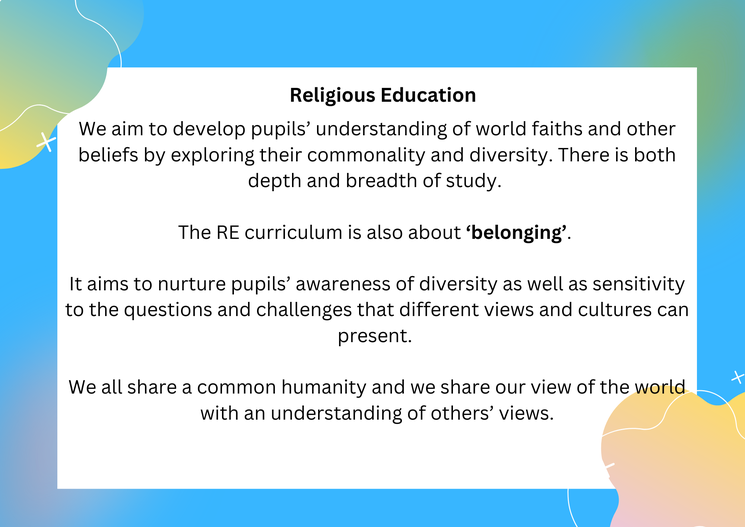
At Acres Hill, we aim to develop the following concepts through the progressive teaching of religious knowledge, skills and understanding. These concepts are based on the requirements of the National Curriculum Programme of Study for Key Stage One and Key Stage Two.
Religious Education is an important part of the work we do in developing the whole child and providing a rounded education. It is one of the ways in which our curriculum can address the wider needs of our learners by stimulating discussion and developing speaking and listening skills. It offers children the opportunity to explore the moral framework that they live their lives by, develops community minded citizens and allows them to access the positive ideas and role models that different religions can offer us.
Religious Education is also a vital tool in promoting our children’s understanding and respect for the beliefs of others. In order for them to be prepared and ready for life in 21st Century Britain, our children need to be able to understand and articulate confidently the beliefs of others in society that may be different to their own. We aim to inspire a curiosity towards the world around us as well as an increased capacity for understanding the core British values of respect and tolerance.
-------------------------------------------------------------------------------------------------------
Religious Education Concepts
These fall into two categories:
 a) concepts which are common to most or all major belief systems such as God, ritual, scripture, festival, prayer, worship, myth and symbol.
 b) concepts which are distinctive of particular religions, examples of which are:
- Christianity: Creation / Fall / People of God / Incarnation / Gospel / Salvation / Kingdom of God
- Hinduism: Samsara and moksha / Brahman (God) and atman / Karma and dharma
- Islam: God/Tawhid Iman (faith) / Ibadah (worship) / Akhirah (life after death) / Akhlaq (virtue/morality)
- Judaism: Torah / The People and the Land
Pupils will develop an understanding of concepts associated with human experience and the search for meaning and purpose such as commitment, celebration, joy, sadness, goodness, evil forgiveness, equality and responsibility. These are central to any area of the curriculum addressing the spiritual development of pupils.
Curriculum Progression- Religious Education
Impact
The impact of our curriculum is measured in terms of the extent to which pupils have developed new knowledge, understanding and skills and that they can use and recall this with fluency.
This will be measured by:
- Lesson drop ins and book looks
- Subject review, feedback and action plans
- Pupil voice – questionnaires, pupil book reviews
- Subject Leader monitoring – Lesson visits, scrutiny of books, assessment, pupil interviews and questionnaires
- External reviews
Collective Worship
All staff and children meet for collective worship, which takes a variety of forms. The content of our assemblies encourages a positive school ethos of tolerance, caring and understanding for all. Assemblies are used to reinforce and develop our school standards.
The Right of Withdrawal from Religious Education:
Religion and belief have become more visible in public life in recent years, making it important that all pupils should have an opportunity to engage in RE. In England, parents and carers have the right to withdraw their children from Religious Education. This right of withdrawal exists for all pupils in all types of schools. The parent of a pupil (or pupils themselves if they are aged 18 or over) may request that they be excused from all or part of the religious education (RE) provided.
Parents who wish to withdraw their children from RE should be aware of its aims and what is covered in the RE curriculum and that they are given the opportunity to discuss this if they wish. It should be made clear whether the withdrawal is from the whole RE curriculum or specific parts of it. No reasons need be given.
Important - limitations to withdraw
- If pupils are withdrawn from RE, schools have a duty to supervise them, though not to provide additional teaching. A pupil may be required to work in another area of the school, such as library or break out area.
- Whilst parents or carers have a right to withdraw children from RE, they should note that children may also encounter religions and beliefs and wider aspects of faith in other areas of the curriculum from which there is no right of withdrawal.
- On occasion, spontaneous questions about religious matters are raised by pupils or issues related to religion arise in other curriculum subjects such as history or citizenship (PSHE) For example, schools promote community cohesion and help pupils to understand ideas about identity and diversity, feelings and emotions within both religious and non-religious contexts.
Managing the Right of Withdrawal
If pupils are withdrawn from RE, schools have a duty to supervise them, though not to provide additional teaching or to incur extra cost. Pupils will usually remain on school premises where it is feasible and appropriate.
Where a request for withdrawal is made, the school must comply and excuse the pupil until the request is rescinded. Though not legally required, it is good practice for a head teacher to invite parents to discuss their written request.
(Section 71(3), School Standards and Framework Act 1998).